Your always-available thinking partner for the Mutual Learning journey — ask questions, revisit ideas from the program, and connect the dots between modules, whenever you need it.
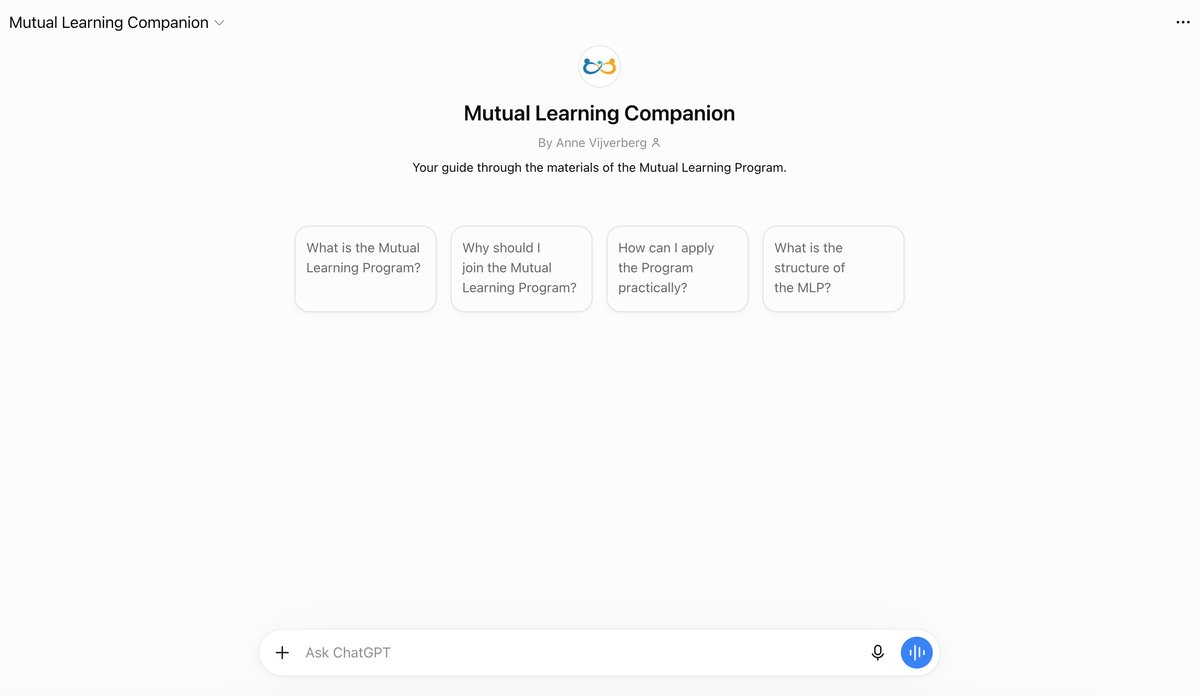
Companion is an AI-powered guide built for the Mutual Learning Program community. It's designed to support participants and practitioners between sessions — helping you think through questions about family and community-based care, revisit ideas from the program, and apply what you've learned in your own context.
Companion doesn't replace the human connection at the heart of Mutual Learning — it's there to complement it, available whenever you need a thinking partner.
The Mutual Learning Companion was created to help participants explore and deepen their learning throughout the Mutual Learning Program. The program brings together a rich collection of ideas and practices around dialogue, collaboration, family and community-based care, family engagement, child protection, and sustainable change.
Rather than simply providing answers, the Companion is designed to support reflection, curiosity and dialogue. It helps learners navigate the program materials, revisit concepts, make connections between different modules and resources, and consider how ideas can be applied in their own context.
You can use the Companion throughout your learning journey. Ask it to explain a concept you encountered in a module, explore a question from a different perspective, connect ideas across the program, revisit a reading or activity, or reflect on how something might relate to your own practice.
For example, you might ask:
The Companion draws on the Mutual Learning Program curriculum and its learning resources, helping you find your way back to the relevant modules, units and materials.
The aim is to make learning an ongoing conversation. The Companion encourages learners to question, reflect, connect theory with practice, and discover relationships between ideas across the program.
In the spirit of the Mutual Learning Program, it recognizes that meaningful knowledge develops through participation, dialogue and relationships—not simply by receiving information.
It is a companion to the learning process, not a replacement for the conversations, experiences and different perspectives that make mutual learning meaningful.